
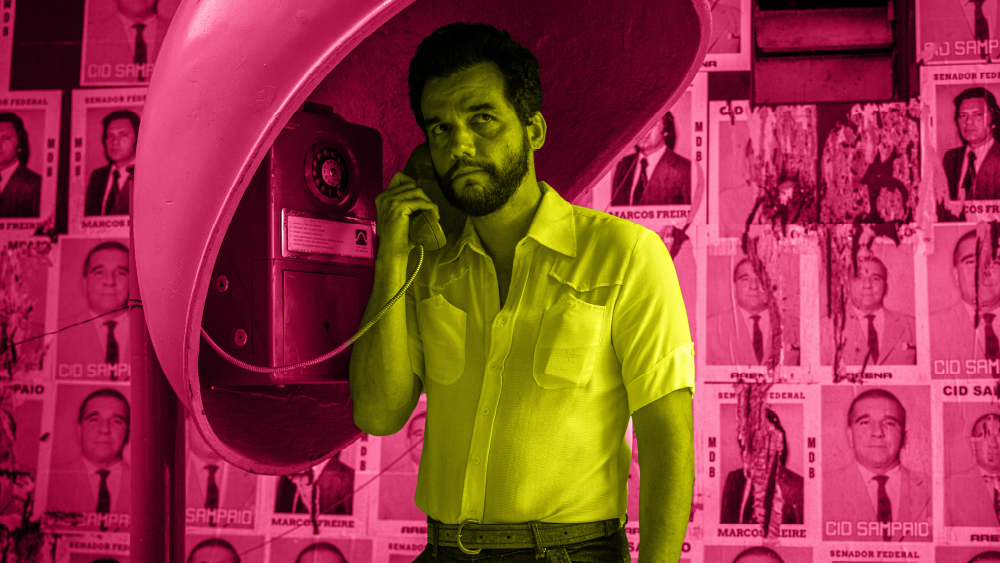

Ushering in a new era at the 92nd Academy Awards, Bong Joon-ho’s Parasite (2019) was the first non-English language film to win Best Picture and remains the only film to have won both the Academy’s top prize and the statue for Best International Feature Film in the category’s 70-year history.
Five years later, the five nominees for Best International Feature Film stretch across Europe, South America and Africa (a noticeable snub of Park Chan Wook’s No Other Choice which would have represented Asia), with Jafar Panahi’s It Was Just an Accident (France), Kleber Mendonça Filho’s The Secret Agent (Brazil), Joachim Trier’s Sentimental Value (Norway), Oliver Laxe’s Sirat (Spain) and Kaouther Ben Hania’s The Voice of Hind Rajab (Tunisia). Four of the five nominees, with the exception of Willa’s distribution of The Voice of Hind Rajab, are distributed by Neon (which also distributed Parasite and would have swept the category had No Other Choice secured a nomination). While Neon’s distribution may now be a telltale sign of success, it cannot ensure victory. Is there anything that can?
The most obvious ingredient is qualifying for official consideration, which stipulates that submissions must be feature-length (over 40 minutes) and produced outside the US (with a theatrical release in its country of origin for seven consecutive days in that year’s eligibility period – 1 October 2024 to 30 September 2025 for this year’s awards), with a predominantly (over 50%) non-English dialogue track (an irrelevant factor for dialogue-free films like last year’s Latvian nominee Flow). While a film may meet all of these criteria, major recent snubs are due to a second layer of eligibility – national selection. Each country is only able to submit one film for consideration, which has rendered recent highly acclaimed contenders like All We Imagine as Light (2024) and Anatomy of a Fall (2023) out of the race completely, despite their success on the festival circuit.
As India demonstrated in their rejection of All We Imagine as Light, some countries do it better than others. Statistically, and unsurprisingly, the Academy prefers European films (which have won 51 out of the 69 statues on offer), particularly those from Italy (the most wins at 14) and France (in second place with 12). Spain, Germany and Japan round out the top five, tied at four wins each, although the Academy’s preference may also be probability, given the same top five have submitted the greatest number of films for consideration. Nevertheless, that statistically puts this year’s trophy in favour of France’s It Was Just an Accident and Spain’s Sirat, although Brazil is on a winning streak (a blessing or a curse), having picked up last year’s win with Walter Salles’ I’m Still Here. If Sentimental Value or The Voice of Hind Rajab were to win, it would be the first ever for Norway or Tunisia.
Recognition in the Best Picture race is also a key indicator of potential success, with 62% of dual Best International Feature Film and Best Picture nominees going on to win the International prize (recent examples being Roma, Parasite, Drive My Car and All Quiet on the Western Front). That gives the edge to this year’s two best picture nominees, Sentimental Value and The Secret Agent – two of the films with the lowest country-favoured odds.
If the answer does not lie in quantitative data, a film’s success may (shockingly) be qualitative. In its last four winners, the International Feature category has shown a preference for films dealing with deeply emotional but universal themes (ideally with historical resonance) and a “restrained” style. Whether it be grief, as seen in 2022’s Drive My Car; the state oppression of 2024’s I’m Still Here; or the denunciation of war and genocide in 2023’s All Quiet on the Western Front and 2024’s The Zone of Interest; recent Best International Features articulate shared human experiences with wide emotional impact – the more universal it feels, the better. All four recent winners have sourced their stories from literary works (a helpful indicator of success if there was a single adaptation in this year’s nominees, which there is not) with the last three winners using historical relevance to exhibit a sense of ethical urgency – dealing with World War I, the Holocaust and Brazil’s military dictatorship – inviting reflection on contemporary violence and oppression through the lens of the past. Those same themes can be seen in over half of this year’s nominations – The Secret Agent, The Voice of Hind Rajab and It Was Just an Accident.
Three of the category’s four recent winners have also been described as exhibiting a calm authority and restrained style of direction. Mahnola Dargis described Ryûsuke Hamaguchi’s direction in Drive My Car as “precise, restrained” while Carlos Aguilar, writing for Roger Ebert, described Hamaguchi’s approach as “never pushing too strongly”. In the London Review of Books, Michael Wood directly references “Glazer’s restraint” in 2024’s The Zone of Interest, while the Hollywood Reporter praised its “unerring control of tonal and visual storytelling.” Stating “Salles doesn’t sensationalise” in his New Yorker review of I’m Still Here, Justin Chang also highlights Fernanda Torres’ performance as a “marvel of expressive restraint”, echoed by Peter Bradshaw’s description of the film as having a “courageously maintained calm”. This year, both Trier and Mendonça Filho display the same sense of directorial restraint in Sentimental Value and The Secret Agent.
Ultimately, it is Mendonça Filho who deals best in secrets – both agents and ingredients – having produced a stylistically restrained Best Picture nominee that deals with the universally-deplored historical issues of political oppression and state violence. Closely followed by Sentimental Value and It Was Just an Accident, The Secret Agent is best posed – on paper – to take home the trophy on March 15.