
I keep coming back to the question of why Sinners felt so big when it first came out. Not just successful, not just well reviewed, but big in a way that was hard to ignore. It didn’t feel like another release in a crowded calendar. It felt like an event. The kind of film people kept bringing up in conversation weeks later, even if they didn’t normally talk about movies at all.
Word of mouth
For a while now, there’s been this idea that cinema attendance is in steady decline, that people would rather wait for streaming than leave the house. I believed that too, mostly because it felt true. But Sinners complicated that assumption. It arrived quietly enough, without the weight of an established franchise behind it, and then it spread. Word of mouth did most of the work. Suddenly everyone had seen it, or was planning to, or was being told they had to.
I remember going to see it shortly after release, sitting in a packed cinema with a friend, and noticing how different the atmosphere felt. It was quiet in a way that’s become rare. Holding their breaths unintentionally at certain moments. No one reached for their phone. No one rushed out when the credits rolled. It didn’t feel passive or distracted. It felt shared, like everyone in the room understood they were watching something that deserved their full attention.
Part of Sinners’ impact comes from how confidently it refuses to sit in one box. It begins as a period drama, shifts into musical territory, and then turns somewhere much darker. By the time the vampire elements fully emerge, the film has already grounded you in character, place, and history. The genre switch shouldn’t work, but it does. That unpredictability is part of what made people talk. You couldn’t easily explain the film without spoiling something, which meant you had to tell people to just go and see it.
Ryan Coogler’s direction plays a huge role in that. There’s a sense that nothing in Sinners exists by accident. The juke joint isn’t just a setting, it’s a sanctuary. The music isn’t just atmosphere, it’s history and resistance and joy all at once. The film is doing a lot, maybe more than it should, but it never feels weighed down by its ambition. If anything, that ambition is what people responded to.
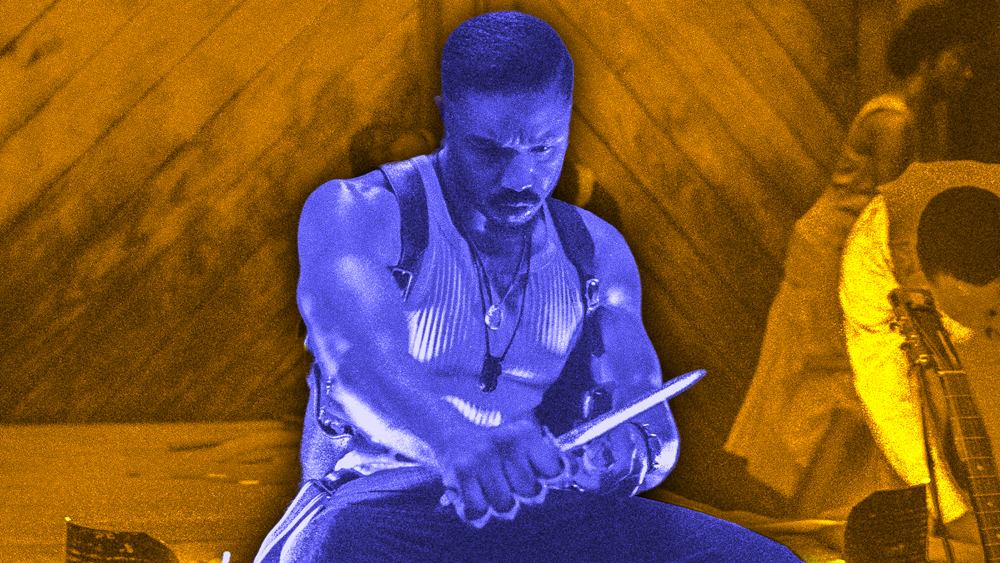
Michael B. Jordan’s presence at the centre of Sinners also became part of its wider impact. Seeing him take on the dual role of the Smokestack twins felt like a statement in itself, not because it proved anything about his ability, but because it asked audiences to sit with complexity. The twins aren’t played for novelty. They’re two lives moving through the same history in different ways, and that duality mirrors a lot of what the film is interested in overall. Around him, the film introduced many viewers to new faces. Miles Caton, in particular, became a point of conversation almost immediately. His voice, his stillness, the way music moves through his character, all lingered long after the film ended and contributed to the sense that Sinners wasn’t just telling a story, but expanding who gets space at the centre of big-screen cinema.
Community. Music. Desire. Fear
What also stands out is how much history Sinners carries without announcing itself as a history lesson. It reckons with the Black experience in America without flattening it into trauma alone. There’s joy here. Community. Music. Desire. Fear. All of it exists at once. The juke joint scenes lingered far beyond the cinema. The reactions and edits people shared weren’t ironic or playful, they were full of awe. It was the kind of sequence that stopped people mid-thought, it mesmerised them and stayed with them. They’re alive. They remind you that cinema can hold celebration and horror in the same frame.
The fact that Sinners went on to earn hundreds of millions at the box office only deepened its impact. It challenged the idea that original, auteur driven films can’t succeed at scale. That audiences won’t show up unless they recognise the brand. Sinners didn’t have that safety net, and it didn’t need it. People came back for second and third viewings because the film rewards attention. You notice new details. New textures. New layers.
Now, with its record breaking 16 Oscar nominations, it feels like the industry is catching up to what audiences already knew. Sinners mattered. Not just as a hit, but as proof of possibility. Proof that cinema can still surprise people. That it can still take risks. That it can still bring people back into theatres for original films in large numbers.
There’s something quietly satisfying about seeing Sinners celebrated in this way. After all the early scepticism, after the predictions that it would fail, it’s hard not to read these nominations as a kind of vindication. Not just for Coogler, but for the idea of cinema itself.
I don’t know if Sinners single handedly saved cinema. That feels like too much to put on one film. But it did remind people why the big screen matters. Why shared experience matters. Why discovering something unexpected in the dark, surrounded by strangers, still feels special.
And maybe that’s its real legacy. Not the records, not even the awards, but the reminder that cinema can still feel alive.
Original Photo Courtesy Warner Bros.