
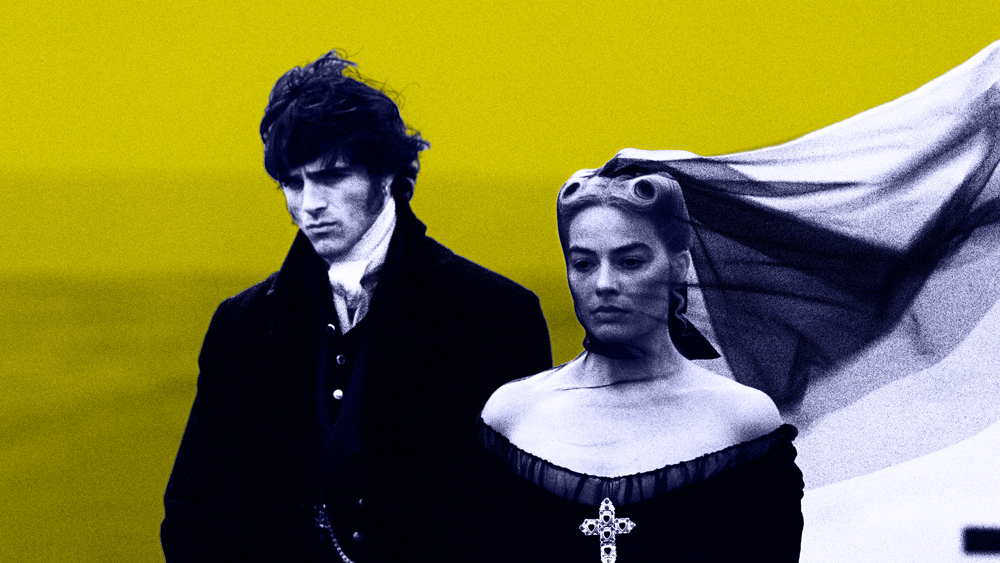

Implying a certain respect for source material, the term “adaptation” is misleading when applied to Emerald Fennell’s “Wuthering Heights”. Fennell hides behind the safety of Brontë’s well-known IP (which will no doubt draw audiences to theatres on its Valentine’s Day release), co-opting names and places from the 1847 novel whilst jettisoning all its complexity and moral ambiguity in favour of an uninspiring, one-dimensional film that is to Wuthering Heights what Fifty Shades of Grey is to Twilight.
A blunt butcher’s knife
Fennell has taken a blunt butcher’s knife to one of the greatest Gothic novels ever written, carving a cheapened love story devoid of any nuance, depth or profundity. In the process, she casts aside the novel’s animating force. It is the abuse Heathcliff endures at the hands of Cathy’s older brother Hindley (who Fennell writes out entirely) which fuels his unquenchable appetite for revenge and thus the events of the novel. A story of racialised classism, Hindley lowers Heathcliff to nothing more than a stableboy on account of his non-white heritage, a rank which Cathy finds “degrading” to marry and ruining their happily ever after.
Wuthering Heights is a cautionary tale of the cyclical nature of emotional and physical abuse. As much a story of hate as of love, Brontë’s Heathcliff exacts his vengeance through domestic violence, animal cruelty and kidnapping in a grudge so powerful it pierces the next generation (the second half of the novel, featuring Cathy, Heathcliff and Hindley’s children, is also ignored by Fennell, despite having been included in both Peter Kosminsky’s 1992 adaptation and Coky Giedroyc’s 2009 TV adaptation).
Fennell’s Heathcliff (Jacob Elordi), on the other hand, is more like a faithful “pet” – as Cathy (Margot Robbie) describes him – with the emotional complexity of a lapdog to match. It is an act of heroic sacrifice – in which Heathcliff takes the blame for Cathy’s wrongdoing – that sees Heathcliff demoted to a servant, an alteration that erases any malevolent or vindictive urges from both the character and the film. This interpretation is a wholehearted dismissal of racism and classism that could only be “imagined” (as Fennell said of her decision to cast Elordi in a POC role) by an upper-middle class white woman whose 18th birthday party was featured in Tatler.
Vapid love affair
Yet the vapid love affair of “Wuthering Heights” does not need the comparison of Brontë’s original to be labelled lifeless and shallow – it achieves that all on its own. Characters are one-dimensional stereotypes following a wearisome chain of events complete with the repeated signposting of the Netflix era. “I will marry you for the sole purpose of tormenting Catherine,” Heathcliff says to Isabella, clearly explaining his plan in a manner the exact opposite of the brilliantly shocking exposés in Fennell’s previous two features, Promising Young Woman (2020) and Saltburn (2023). “We’re doomed,” Cathy announces ten minutes in, just in case you were wondering.
It unsurprising, then, that this iteration of Cathy and Heathcliff are flat and unremarkable. Robbie and Elordi give lacklustre performances and are easily outshined by their fellow cast members (including Charlotte Mellington’s performance as a Hermione-inspired young-Cathy and a scene stealing Alison Oliver as Isabella Linton). Robbie’s Cathy has the privilege of one personality trait – selfishness – which drives her internal battle between the lowly Heathcliff and the sumptuous riches of the Linton estate (a struggle loyal to Brontë’s Cathy). It is Elordi who has the hardest time. His Heathcliff simply broods, blankly trudging through the lines “you’re wet, you’re cold” and “oh no” in the film’s finale. This renders any faithful dialogue (“I cannot live without my life, I cannot live without my soul,” Heathcliff suddenly says) vastly out of place in Fennell’s universe.
The film’s paltry intensity renders Fennell’s ostentatious production jarring, in a manner that recalls a music video (for Charli XCX’s excellent soundtrack) or a pantomime. Its fantastically intricate elements (like Cathy’s ‘skin room’, made with real scans of Robbie’s skin) are constantly at odds with the film’s maddeningly vacuous story. Rather than enhance, the extravagance only serves to exaggerate the film’s already obvious statements. Cathy is vain – can you not tell by her glitter freckles, monstrously massive necklaces and pure organza gowns?
A soulless romp
A soulless romp, Fennell has chosen to focus on the “sadomasochistic” elements of a novel where physical intimacy is notably absent. To achieve the intended effect, the film features an overtly sexualised public hanging, raw egg porn and (a meagre amount of) horse reign bondage, yet relegates Robbie and Elordi to maddeningly boring makeout sessions. Perhaps this is Fennell’s own sadomasochistic way of deriving pleasure from the pain of her audiences, in a film where the only trace of torment is inflicted onto the viewer.
2/5


