

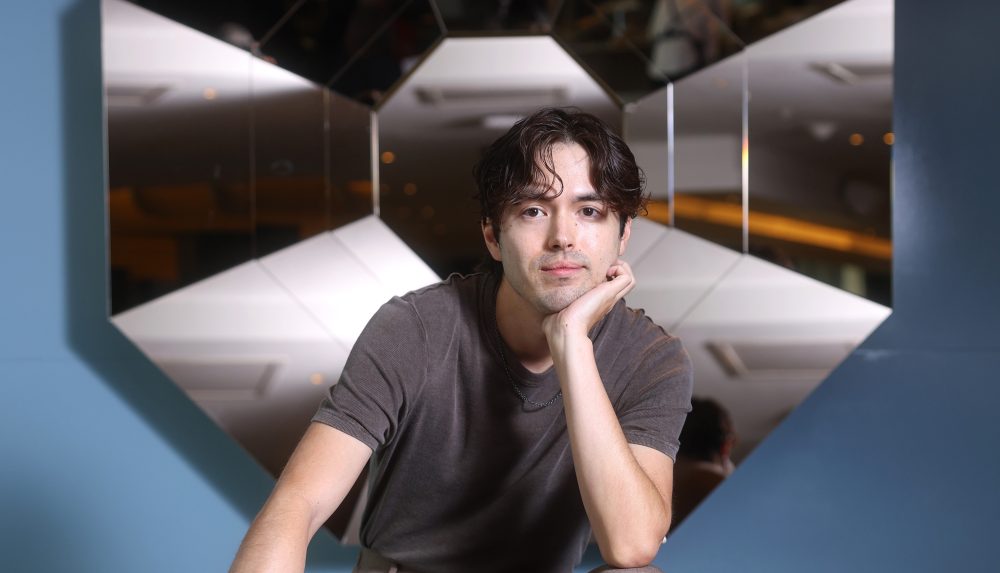

James Sweeney is proof that inventive filmmaking must sometimes ignore what came before it. During his time at Chapman University, there was a moment when a professor tried to find a film all 200 students had already watched. “I hadn’t seen any of the films she was mentioning,” Sweeney admits. After slowly eliminating all the major Hollywood blockbusters of the last half-century, the professor assured her students everyone had seen her final suggestion: Star Wars. “Every other student raised their hand except me, and I’m like, oh my god!”
A multi-hyphenate filmmaker, Sweeney wrote, directed and starred in one of the most original comedies of 2025, Twinless, which won the Audience Award (Dramatic) at Sundance and landed Sweeney a spot on Variety’s 2025 Directors to Watch. His second feature film, it follows Dennis (Sweeney) and Roman (Dylan O’Brien), two grief-laden young men who meet in a twin bereavement support group and quickly form a co-dependent, twin-like bond.
For Sweeney, Twinless is – at least in part – autobiographical. Now in his mid-30s, he began writing the script over ten years ago. “My identical twin boyfriend had recently broken up with me,” he says. An only-child, he had “always had a fascination with twins.” The relationship and ensuing breakup “resurfaced those feelings from when I was younger.”
The concept for the film sharpened further when Sweeney discovered the existence of a twin bereavement support group. “It struck me as such a singular and profound sort of grief.” Twin relationships became Sweeney’s lens to examine identity. The same framework exists in Sweeney’s first feature Straight Up (which he also wrote, directed and starred in), in which obsessive-compulsive brainiac Todd, played by Sweeney, suffers such an intense fear of loneliness it leads him to question his sexuality.
In both films, Sweeney writes his leading men as misfits. They violate social norms, have few – if any – friends, and exhibit dry, intellectual, cutting personas that are fun to watch but (probably) hard to spend time with. Both characters are aware of their outcast status, actively adjusting their personalities, sexualities and family history to ensure they don’t end up alone – the worst possible scenario, as Todd reveals to his therapist.
With both films hinging on crippling fears of loneliness, Sweeney gives voice to an increasingly relevantconcern for younger generations. Attempts to avoid this fate are also met with a droll cynicism, including the treatment of Millennial dating sites (from ball pits to couples Halloween costumes and immersive art experiences). Sweeney captures the fears of a generation from the inside.
He also hides a genuine humility not often seen in actors – or directors. “I’m going to sound so uncultured,” he complains when he forgets the name of L’Arrivée d’un train en gare de La Ciotat (1896), one of the earliest motion pictures ever made. The remark speaks more to Sweeney’s perception that he is outside the industry machine and its folklore – the same belief that allows him to operate outside its conventions.
“I try to have an awareness of what has preceded me,” he says of his approach to writing and filmmaking, adding that until film school, resources were slim. “I grew up in Alaska, where there was only one local movie theatre,” he says. “I was uninfluenced. I didn’t really grow up watching a lot of movies.”
The antithesis to many directors’ coming-of-age stories, this blank slate was a blessing. While it may have caused embarrassment in film school where Sweeney remembers “feeling so uneducated,” it ultimately set him apart from his peers. “Filmmakers who were so inspired by one specific director or film maybe struggled to find their own voice at that stage in their career. I feel like some of my most original ideas came from when I had the smallest rolodex of references to pull from.”
Unburdened by the weight of film history, Sweeney’s mind was free to create truly unique and surprising stories. As he expressed in a 2025 interview with Filmmaker Magazine, Sweeney believes “modern audiences are attuned to structural tropes and plot contrivances…I operate from the assumption that audiences are sophisticated.” He stands by his statement: “Oh wow,” he says, “that was so smart of me.”
Twinless not only subverts plot contrivances, but both Sweeney’s films offer layered female characters written with complexity. In Twinless, Marcie (Aisling Franciosi) first appears as a sickly-sweet airhead before deploying unparalleled insight and discernment that drives the film’s second half. “We initially see her through Dennis’ eyes,” Sweeney says of the character’s transition. “When the plot unfolds, we understand she has much more emotional intelligence than was initially let on.”
In Straight Up, Rory (Katie Findlay) is an aspiring actress who uses auditions and her improv class to offer reflexive satire of stereotypical female characters. She is nuanced, multifaceted and intellectually distinctive. “It’s part of my way of subverting expectations,” Sweeney explains of his approach, “I lead with empathy towards all characters and an understanding that we’re all the protagonists of our own films.”
Sweeney credits his experience in front of the camera to creating well-developed characters. “I try to make sure every character has something – even if they only have two lines in the film. I want to make sure they have a point of view.” This additional insight supplements his dialogue driven scripts, a remnant of his playwriting background. “It’s pretty sparse in prose,” he says of his screenplays, “you let the actors read between the lines, so that’s how I write.”
Reading between the lines, however, is not always helpful when selling a film. Sweeney admits his multi-hyphenate approach may have its drawbacks. “Maybe it’s part of the reason people didn’t fully jump on board with the script,” referencing his difficulty securing financing for Twinless. Sweeney admits “everybody in Hollywood passed. They didn’t see it the way I saw it – I’m seeing how I plan to direct it and perform it,” he laughs. “Maybe that means as a writer I need to make that clearer.”
Ten years in the making, Twinless was well received by critics who praised its inventive concept and dark wit. “Somebody told me last night they thought the script was, five years ago, ahead of its time. My reaction to that was: ‘Has that much changed in five years?’” His own worst critic, Sweeney’s doubt speaks more to his place on the fringes of the industry than the quality of his stories. Whether he believes in his own innovation or not, he is characteristically humble about what’s next. “I don’t really think anything is original anymore, so I’m not trying to chase that.”


