
It’s become no extraordinary occurrence for British feature debuts to make waves at international film festivals (think Charlotte Regan’s Scrapper or Molly Manning Walker’s How to Have Sex, Luna Carmoon’s Hoard or more recently, Harris Dickinson’s Urchin), but there is nowhere better to survey the next round of standout British debuts than the London Film Festival. This year, the best debuts took us from Lagos to Luton, dealing with violent prisons and BDSM-biker gangs, with many offering a fresh approach to cinematic form.
Wasteman (Cal McMau)
A prison-thriller that balances subtle critique with entertainment and suspense, Wasteman takes a claustrophobic, fly-on-the-wall approach to incarceration. Ten years in the making, McMau rewrote the role of Taylor (a timid inmate with a – manageable – drug problem) for the remarkable David Jonsson, whose attempt at early release is complicated by the arrival of his new cell mate, Dee (Tom Blyth).
Set to a constant cacophony of shouting, clanging metal, buzzers and fighting, the film is interspersed with footage from social media, adding to the frenetic feeling of constant surveillance. Watching is a visceral experience and McMau steadily builds tension to a satisfyingly unexpected conclusion.
Ish (Imran Perretta)
One of the most visually imposing films at the festival, Ish is the first foray into feature length film for established visual artist and composer Imran Perretta, who displays a distinct cinematic eye. Shot in black and white in Luton, Perretta’s monochromatic approach has a visual poeticism that captures the grandeur and monumental beauty of the airport town.
The film follows the eponymous Ish (Farhan Hasnat) and his friend Maram (Yahya Kitana) as they deal with racial profiling, police oppression and the constant shadow of the war in Gaza. Set to an ethereally haunting soundtrack (also composed by Perretta), Ish is an impressive debut that deftly blends aesthetic vision and political commentary with a nuanced coming-of-age story.
My Father’s Shadow (Akinola Davies Jr)
While we are only with brothers Remi (Chibuike Marvelous Egbo) and Aki (Godwin Egbo) for one day in Akinola Davies Jr’s evocative debut, My Father’s Shadow already has the haze of memory. Soulless voices echo from the forest, birds circle overhead. “Dear Father,” it begins, “I will see you in my dreams.”
An exploration of personal mythmaking for Remi and Aki, but also Davies Jr himself (who co-wrote the script with his brother), the film is grounded by a spellbinding performance from Sope Dirisu (Slow Horses, Gangs of London) as Florian, the boys’ father. Its atmospheric power has such potency that you can imagine, in twenty years’ time, Remi and Aki recalling this day.
Pillion (Harry Lighton)
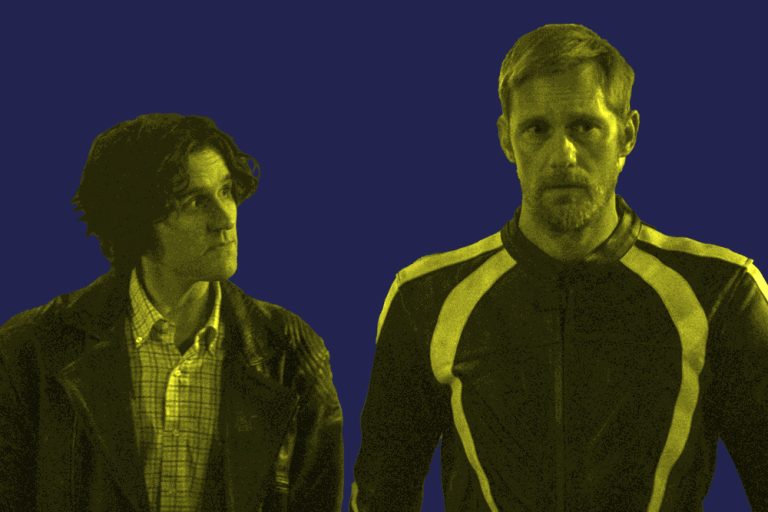
Harry Lighton’s directorial debut, based on the 2020 novel Box Hill by Adam Mars-Jones, follows Colin (Harry Melling), a timid and lonely man who meets the incredibly handsome Ray (Alexander Skarsgard), an inscrutable biker whose relationships must adhere to the strict rules of BDSM.
Impressive in its ability to switch between funny and forlorn, the film uses a British charm (barbershop quartets, Tesco carrier bags and a Chislehurst name-drop) as an amusing foil to the leather and sex subculture. Melling’s performance is outstanding, with impeccable comedic timing and a general pitifulness that allows the film to transcend the banalities of traditional romcoms.